Are All Continuous Joist Over Interior Walls Load Berring

Hey Noah, What Are Load Bearing Walls?
Hey Noah, What Are Load Bearing Walls?

As a structural engineer, I seem to be the go-to guy among my friends and family when someone wants to know if a wall in their home is load-bearing or not. When I get that phone call I often think to myself "Do they even know what a load-bearing wall is?". So first off, I think I should explain what classifies as a load-bearing wall and how they work, and then I can go into explaining some ways I determine if a wall is load-bearing when I am helping out with my friends and family.

Some of the reasons someone would ask this question in the first place would be one of a few things. One reason would be curiosity. If you are like me, you may have that curiosity gene that just wants to learn about how things work and are constructed. The main reason would be that they are doing a renovation at their home or business that requires a wall to be removed or modified to have new door/window openings as they are worried that the structure will collapse. Nowadays it is becoming more trendy to have an open floor concept. That means that people want to get rid of their ugly walls that don't do much for their space.
A load-bearing wall is any wall that holds up the weight of the structure above and the people/furniture supported by that structure. The floors above, roof structure, people and furniture are the "loads" that the wall has to support. A load-bearing wall transfers load all the way down to the building's foundation. In a multi-storey building, load-bearing walls usually line up with each other from floor to floor, but this is not always the case. In a house, for example, the floor plans from floor to floor are often not consistent, so where there is a bearing wall on an upper floor there may be an open space on the floor below. You may be asking, "But where does the load go if the wall just disappears?". Well, I can tell you that load doesn't just magically disappear, it needs to be able to make its way down to the building's foundation somehow. In these cases, a transfer beam or lintel is installed below the bearing wall to carry the load to each side of the opening at the lower floor. There can also be situations where a load-bearing wall sits on the floor joists which transfer the load to adjacent walls and beams.
Other than transferring load, the role of a wall in a building include:
- To separate rooms and spaces
- To provide acoustic separation and prevent sound travel
- To prevent fire from spreading from one space to another
- To provide aesthetics to a space
- To provide shelter
- To enclose conduits and plumbing
- To provide security (can't we all just get along?!)
So now that you know what a load-bearing wall is, it's time for some tips on how to determine if a wall is load-bearing or if it is just a partition wall that can be moved or altered with so major structural implications. It is not always easy to determine if a wall is load-bearing without having access to the ceiling or attic space to visually inspect the framing.


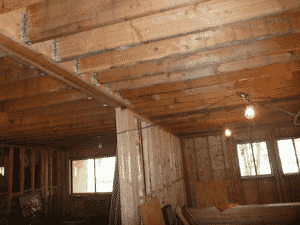
If you are able to see the floor framing or roof framing, you fir st want to locate the floor joists or roof trusses. If the wall in question is parallel to the joists/trusses, it will likely not be load-bearing. An example of a non-load bearing partition wall can be seen on the left.
When joists/trusses are perpendicular to the wall and bear o n the top of the wall, that wall is bearing wall. An example of a load bearing wall call be seen on the right.
Joists are rarely continuous over the top of a wall, instead, they are often spliced over the top of the wall as dimensional lumber only available in specific lengths. For an idea of the standard lengths of dimensional lumber click here .
If you don't have access, it is safe to say that all exterior walls are load-bearing. Exterior walls resist wind loads as well as roof and floor loads. If there is an interior wall that is continuous and in line with a wall above or below, there is a better chance that it is a bearing wall compared to section of short walls that jog in and out. If you only have access to the wall framing and not the ceiling/attic space to see the joist/truss direction, then tightly spaced or deeper wall studs could be a sign that it is load-bearing since a heavily loaded wall would require more studs and a larger stud area to resist the applied loads.
 Floor joists that frame into an exterior wall will need to be supported at the opposite end by a bearing wall or beam. The joist span depends on the wood species/grade, applied load and joist depth/spacing but a good rule of thumb would be that a joist will span between 10 and 20 feet (3 and 6 m). So if a wall is a distance away from an exterior wall that is within this range then there is a better chance that it is bearing compared to a wall that is only a few feet away from the exterior wall. Roof trusses can span much longer distances than joists, so if you have a gable roof the re is a good chance that it can span between exterior walls and not require an interior bearing wall for support. This means that at the top floor of a house, the interior walls may not be supporting the weight of the roof structure and the weight of snow. For an idea of the standard spans for roof trusses given the snow load, truss member pitch, size and spacing, click here .
How to Remove a Load Bearing Wall?
Now that you know how to determine if a wall is load-bearing, you may be wondering what is required if you are wanting to remove one.
When removing a bearing wall in a residential home, a beam or lintel is required to replace the wall and carry the load to each side of the opening. A beam can either be dropped and have the floor joists sit on top of it, or the beam can be in the same plane as the joists having the joists frame into the side of the beam.

Flush framing joists into the side of the beam is a more expensive option as it can involve cutting the joists and installing joist hangers at the ends of the joists. This option, however, can eliminate the need for a bulkhead that would be required if the beam was dropped, which leads to a cleaner look. The size of the beam and posts required is a function of the amount of weight that the beam will support and the width of the opening. Sometimes, installing a beam and posts may not be all that is required when removing a bearing wall. The structure below the bearing wall will need to be looked at as well. If there is a bearing wall below, a post will need to be added to continue the load down to the foundation. If there is a beam below, it may need to be reinforced depending on where the post is located along the span of the beam.

But wait, there's more… The foundation needs to be assessed to make sure it can handle any additional loading that may be introduced as adding an opening in a bearing wall alters the load path. If the foundation cannot handle the increased load, reinforcing of/or adding to the foundation will be required which can be very messy and costly.
It is critical to shore the floor joists prior to removing the wall. Shoring in this case involves temporarily supporting the weight of the floor structure that was originally intended to be supported by the wall being removed. This can be done by installing temporary beams and posts (shown on the left), or by building a temporary stud wall.
If a bearing wall is removed without installing shoring beforehand, this could lead to a collapse of the structure and would create a safety hazard.
Most jurisdictions require permits for the removal of a bearing wall, so If you are wanting to remove a wall in your home, it is highly recommended to consult with a professional structural engineer. But now that you know which walls could be bearing and what is involved in their removal, it will hopefully help you in the planning and budgeting stage of your next home renovation project. If you have any questions or comments on the content, feel free to leave a message in the comment section below!
To learn more about the basics of structural engineering, access our FREE guide here.
- Author
- Recent Posts

Noah is a professional engineer working at Crosier Kilgour & Partners Ltd, a structural engineering consulting firm in Winnipeg, Manitoba, Canada, and has over 8 years of experience working in the engineering profession as a structural designer and project manager. He has worked on many unique projects throughout his time in the engineering field including condition assessments of existing structures, renovations to existing buildings, additions to existing buildings, and the design of new structures that he gets the privilege of seeing thembeing built from the ground up in the city he grew up in.
Tags
You may also like
hernandezentes1943.blogspot.com
Source: https://structuralengineeringbasics.com/how-to-tell-walls-load-bearing/
0 Response to "Are All Continuous Joist Over Interior Walls Load Berring"
Post a Comment